


VoIP Virtual PBXs: The importance of the provider for quality IP
VoIP virtual PBXs use voice over IP solutions to make calls over the Internet instead of the traditional telephone network. For companies looking to fully optimize corporate communications, it is essential to understand how this technology works and what to consider in order to implement it successfully.
Below, we detail the basic features of VoIP PBXs, their advantages and disadvantages compared to traditional systems and how to choose the best service provider for you to enjoy all the benefits they offer.

What is Voice over IP (VoIP)?
Voice over IP stands for Voice over Internet Protocol. In conventional telephony (PSTN), calls travel over physical copper telephone lines. VoIP, on the other hand, converts the sound of a conversation into digital signals and transmits them over the Internet in the form of data packets. By using packet-switched technology instead of telephone circuits, VoIP makes efficient use of the network: multiple conversations can flow over the same shared data connection.
To use this technology requires a VoIP service or application, broadband Internet access, and usually a SIP trunk provided by a VoIP operator to interconnect with the traditional telephone network when calling fixed or mobile numbers.
A virtual PBX (IP PBX in the cloud) is the logical evolution of PBXs: it works as a cloud service provided by an operator, hosted in the provider's redundant data centers, so that the user company only needs a good Internet connection to use it.
Operation process of a VOIP virtual PBX:
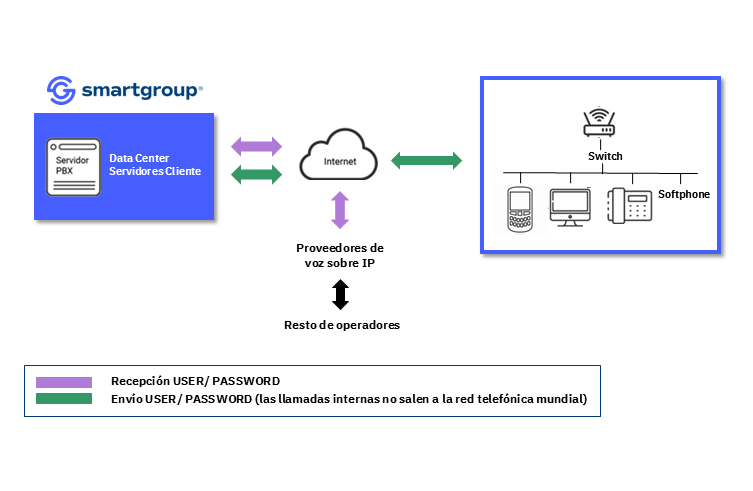
- To make calls, the user can use a physical IP phone, an application installed on his computer or cell phone and webRTC (access to the platform via browser).
- The user has credentials and an internal extension within the system. The extension could be configured on as many devices as desired. For example, the same internal number could ring at the same time on the office phone and on the employee's cell phone.
- The user logs on to the platform, leaving his terminal connected to the service.
- When a call is originated, the virtual PBX uses Session Initiation Protocol (SIP) to route it to the appropriate recipient: if it is an internal extension of the same company, it connects both users directly via the Internet; if it is an external number in the public network, then it sends the call through the VoIP provider to the PSTN.
- From the perspective of the external user calling the company, it makes no difference: the company will have one or more public telephone numbers (DIDs) associated with its virtual PBX, so that external customers or contacts will dial those numbers and the incoming call will be handled by the VoIP platform in the cloud. It is even possible to port the company's traditional phone numbers to the VoIP platform, making the migration transparent to callers.
The virtual PBX handles all call management protocols centrally. This includes sophisticated functions that are difficult to achieve in classic PBXs: time-based routing rules, personalized greeting locutions, call jump groups, interactive voice response (IVR) systems and automatic call distribution (ACD) to manage waiting queues.
What are the advantages of a VOIP PBX over traditional voice?
- Multiplatform versatility and ubiquity: Allows transmission to smartphones, computers, tablets and IP phones in a cost-effective way. Users are not tied to a fixed phone in an office, enabling teleworking and geographically distributed operations. In addition, more than one simultaneous call can be handled over the same data connection, making it easy to scale communications without adding additional physical lines.
- Scalability and ease of adding lines: it is easy to reduce or increase the number of extensions or lines available by simply configuring software, without installing new cabling. It becomes a configuration task in the virtual PBX, with very low marginal costs compared to expanding a traditional PBX. In fact, VoIP has already been widely adopted, and in many industries it is already the dominant form of telephony, replacing conventional fixed lines.
- Built-in advanced functionality: many features that used to cost extra are now included or easy to implement with VoIP. For example, call forwarding, Caller ID, voicemail, automatic redialing and even call recording and intelligent forwarding. It also facilitates unified communications, integrating video conferencing, instant messaging and real-time collaboration.
- Cost savings and infrastructure reduction: no extensive dedicated infrastructure is required: the system can be installed quickly and grow on demand. For example, with mobile applications and web clients(softphones), it is not even necessary to purchase expensive desk phones for each employee, which reduces the initial investment for SMEs. Long-distance calls are often much cheaper or even free within the corporate network, and rates to external phones are lower than with conventional telephony.
- Call quality and performance: with a high-capacity Internet connection, they provide better voice quality with very low latency. Voice over IP protocols are optimized for real time, so that the user experience (dial, talk, hang up) is almost the same as that of a classic telephone, provided there is adequate bandwidth and traffic prioritization (e.g. through QoS in the local network).
What disadvantages does it have over traditional voice?
- Dependence on Internet and electricity: is completely dependent on Internet connectivity and power supply. If the company suffers connection problems (extreme slowness or drops) or a prolonged power outage without power backup, the VoIP phone system will stop working until these services are restored. For this reason, redundant Internet connections and uninterruptible power supplies (UPS) are recommended for critical VoIP environments.
- Quality subject to data connection: VoIP call quality may vary depending on the stability and bandwidth of the connection. A congested or low-speed network can produce delays, jitter or packet loss, affecting voice clarity (robotic or choppy voice). It is important to correctly size the Internet link for the expected call volume and apply QoS. Many businesses opt for a dedicated VoIP-only connection or segment the network to prioritize voice.
- Vulnerability to cyber-attacks and network failures: VoIP can be subject to cyber attacks or network outages. Threats such as denial of service attacks (DoS/DDoS) targeting SIP servers, phreaking attempts (fraudulent use of the PBX) or call interception are present risks. Traditional PSTN lines did not have these attack vectors. In any case, most incidents can be mitigated with good security practices, and service continuity on quality platforms is usually very high.
Who might be interested in Voice over IP?
- Companies of all sizes: from small startups to large multinational corporations. For SMBs, VoIP offers the ability to access advanced communications capabilities without the high investment that a traditional high-end switch would entail. For large organizations, VoIP provides almost unlimited scalability and the unification of communications across multiple sites on a single centralized platform.
- Call centers and contact centers: can quickly grow or reduce the number of telephone agents, even by implementing home-based remote agent schemes. Native IP PBX features such as ACD (automatic call distribution), intelligent routing, call recording and real-time monitoring are ideal for improving the efficiency and quality of these centers. In addition, the cost per call is often lower, which is critical in high call volume environments.
- Companies with remote staff or multiple locations: organizations whose workforce is geographically dispersed (different offices, telecommuting, field sales teams) find VoIP the solution to keep everyone communicating under the same system. All team members are "on the same switchboard" even if one is in Madrid and another in London.
- Growing businesses or businesses with seasonal peaks: those businesses whose size or demand for communications varies over time (e.g., retail companies in peak season, or rapidly expanding startups) appreciate the scalability of VoIP. They can add lines and features in a matter of minutes during a peak, and then drop them if they are no longer needed, paying only for what is used. This elasticity is difficult to achieve with traditional telephony systems where capacity is limited by installed hardware.
In short, any organization looking to reduce costs, gain flexibility and access advanced communications features should consider a VoIP solution. Today, IP telephony has become prevalent in many industries because of these benefits, so falling behind with traditional technology can mean losing efficiency and competitiveness.

What should you consider when choosing a VoIP provider?
- Secure servers and high availability: the provider must have a reliable server infrastructure, ideally with Tier III or higher level data centers, and with geographic redundancy. This means that if one data center fails, another will automatically take over, guaranteeing service continuity. A good provider implements geo-redundant platforms, capable of switching to a backup center in case of failure of the main one. Likewise, servers must incorporate strong security measures (firewalls, signal encryption, SBCs) to protect VoIP communications against external attacks. Tier III certification of a data center indicates, for example, service availability of more than 99.98% per year and redundant N+1 power and climate control systems, key aspects for keeping the VoIP platform always online.
- Professional call routing: the provider must allow the design of call routes and advanced configurations according to business needs. This ranges from IVRs (interactive voice menus), skip groups, hold queues, to time rules or call origin routing. Well-designed routing ensures that callers have a smooth and consistent experience.
- Stable connectivity and backup: the provider has to offer backup solutions in case of network failures, since the virtual PBX is totally dependent on the connection. Many companies opt for professional fiber links with 4G/5G backup, so that if the main connection fails, the router automatically switches to the mobile network to keep the service active. Having a redundant link ensures uninterrupted operations even in the event of fiber cuts or problems in the main network. It is also recommended that the VoIP solution supports QoS (Quality of Service) mechanisms in the local network, to prioritize voice traffic over other data and thus maintain the quality of calls even when they coexist with high bandwidth consumption.
- Dedicated lines and guaranteed bandwidth: for companies with very high traffic requirements or strict quality guarantees, the use of dedicated lines can be evaluated. Some providers offer SIP trunks over dedicated links (not shared with the general Internet) that ensure bandwidth reserved 100% for voice, with service levels (SLA) of, for example, 99.9% availability. Although it usually involves higher cost and custom projects, a dedicated line eliminates competition with other services on the network and provides the highest reliability and lowest possible latency. This type of solution is ideal for companies that cannot risk even the slightest outage in their communications (e.g. emergency centers, large call centers, etc.).
In summary, when evaluating VoIP providers you should look for security, high availability, configuration flexibility and connection backup. A reliable provider will not only provide good rates, but will also guarantee that the communications platform will always remain operational and that it will adapt to the changing needs of the business in a secure manner.
At Smartgroup we meet all these requirements and, thanks to our professional team, you can enjoy an expert provider with more than 15 years of experience in telecommunications.
Do you have more questions? Contact us to ask for your personalized, no-obligation quote. And follow us on LinkedIn to keep up to date with all the latest news.
