

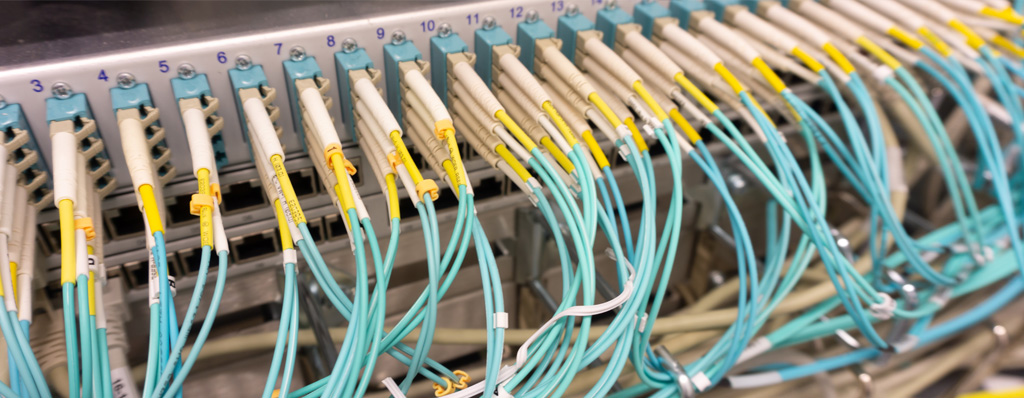
Enterprise structured cabling: The foundation of an efficient and secure network
Have you thought about improving your company's communications through structured cabling? It is much more than a set of cables: it is a physical and logical telecommunications infrastructure designed under standards to integrate technologies in a coherent way. Unlike improvised cabling, it is meticulously planned and organized, acting as the backbone of communication networks in any modern enterprise.
Its objectives include minimizing interference and noise, maximizing connection stability and ensuring fast, secure and reliable data transmission. In other words, good structured cabling prevents data loss problems or communication failures that can dramatically affect a business.
All corporate cabling installations must be properly certified and approved according to current regulations, ensuring technical reliability and legal compliance. International (ANSI/TIA, ISO/IEC, CENELEC, etc.) and local standards define design, material and testing requirements that must be met. In fact, many authorities require certified installations to grant operating licenses, avoiding penalties and legal risks.
Here are the main features of this technology.

Quality, certification and network maintenance
At Smartgroup we only work with high quality materials and internationally recognized brands. A cabling system is only as strong as its weakest component. In addition, an installation done by trained technicians following good practices avoids connectivity problems and additional costs due to errors.
After installation, extensive testing (continuity, speed, attenuation, etc.) is performed to certify that each link supports the required performance and complies with international performance and security standards.
Our service is not limited to installation: we offer preventive and corrective maintenance that protects your company's investment and ensures the operational continuity of the network. Structured cabling, being the foundation of the IT infrastructure, also requires periodic monitoring - e.g. patch panel connection review, labeling and ordering, link testing - to detect and correct any degradation in time. In this way, we reinforce our commitment to the stability and technological performance of each organization, avoiding costly interruptions.
Structured cabling categories: choose the best option
Structured cabling is the backbone of any network, and choosing the right category of cable is key to optimizing speed, stability and reliability. There are different categories of Ethernet (twisted pair) cable that are distinguished by their performance and recommended use:
- 🔵 Cat 5 → Up to 100 Mbps. Today it is obsolete in most modern environments.
- Cat 5e → Ideal for homes with standard internet. Speeds up to 1 Gbps, sufficient for streaming, video calls and surfing.
- Cat 6 → Perfect for small offices or telecommuting. Offers up to 10 Gbps over short distances and greater interference control.
- Cat 6a → Recommended for enterprise and high-demand environments. Maintains 10 Gbps over distances up to 100 m, with high stability.
- Cat 7 → Designed for environments with high electromagnetic interference. Its superior shielding gives it robustness, with the same performance as Cat 6a.
- Cat 8 (8.1 and 8.2) → Data center level. Offers speeds of 25-40 Gbps. Ideal for enterprises with servers, virtualization and critical network needs.
In general, the recommended categories are Cat 5e or 6 for homes, Cat 6a or 7 for offices and medium-sized companies, or Cat 8 for critical infrastructure.
Beyond connection: reuse and optimization
In the world of enterprise networking, Ethernet cables are essential for stable, high-speed connections, but their usefulness goes beyond simply "connecting" devices. An additional benefit of good structured cabling is the ability to reuse existing cables when expanding or reconfiguring the network, as long as those cables meet the necessary specifications. For example, if an office has Cat5e runs in good condition, these can continue to be used to extend access points or for IoT devices, avoiding incurring unnecessary costs in certain areas. This flexibility is especially valuable for companies (and homes) looking for efficiency and savings, as it allows the infrastructure to be scaled gradually, taking advantage of resources already installed.
To obtain maximum performance and reliability from any structured cabling, it is essential to apply correct installation techniques and use the appropriate tools. Crimping the RJ45 connectors on each cable ensures a firm and stable joint, avoiding false contacts that degrade the signal. Professional crimpers are rightly used to crimp the connectors to the cable ensuring a solid and reliable connection. Equally important is the verification of the continuity and quality of each link with specialized cable testers. Cable testers allow you to quickly check for cut, reversed or shorted wires, detecting faults such as crossed pairs or poor connections in Ethernet cables.
In short, structured cabling for enterprises should be considered a strategic investment rather than an expense: it is the foundation on which a robust, secure and scalable network is built, ready to support the challenges of digital transformation.
Contact us to request your personalized quote with no obligation. And follow us on LinkedIn to keep up to date with all the latest news.
